
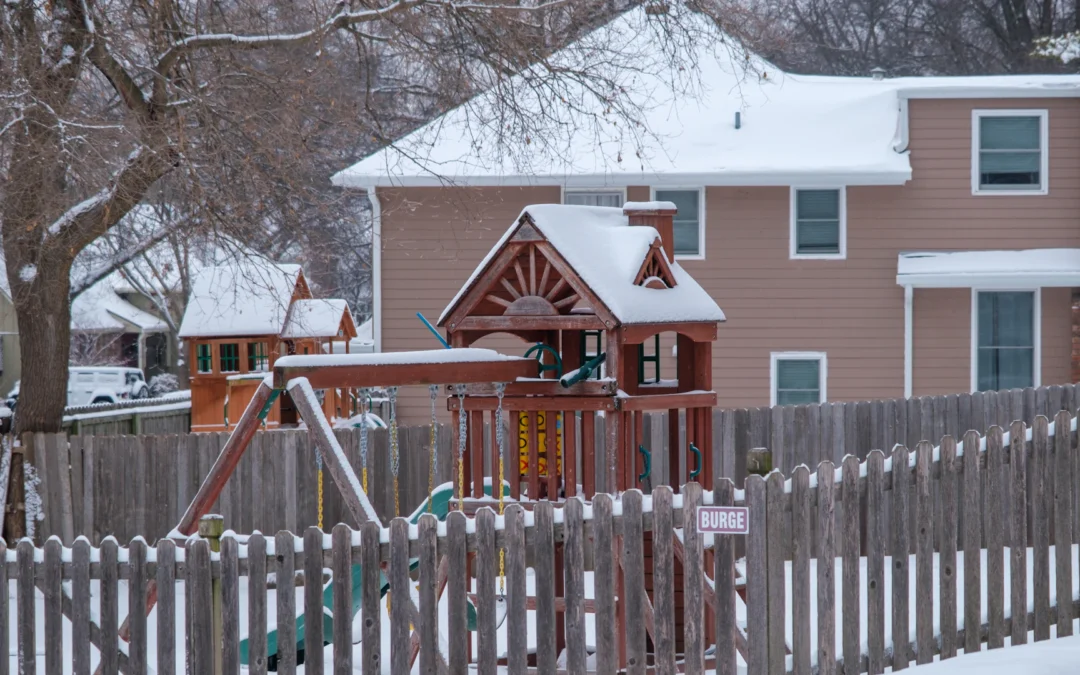
Front Range storms arrive fast and leave in twenty minutes, and the damage they do to a backyard playset is rarely obvious from the kitchen window. A set can look untouched and still have a cracked slide wall, a racked A-frame, or a hardware connection that lost its bite. This is a walk-around for the morning after, organized by what the storm did rather than by which part you are looking at, because storm damage does not respect part boundaries.
If you are looking for the routine monthly check, that is a different job, and we cover it in our standing playset safety inspection. This post picks up where that one leaves off, with the three storm types that actually reach backyards in Colorado. Everything here reflects what our crews at Rainbow Play Systems of Colorado find when homeowners call us out after a bad night.
Before you start: the sixty-second safety call
Do this first, before any detailed inspection.
- Keep children off the set until you have finished the walk-around. Not “supervised on it,” off it.
- Look up. Overhead limbs that cracked but did not fall are the single most dangerous thing in a storm-damaged backyard, and they are not a playset problem you can fix.
- Check for downed or sagging utility lines anywhere near the structure. If you see one, stop, stay clear, and call the utility.
- Walk the perimeter for debris that has blown into the fall zone, especially anything with exposed fasteners or glass.
Only once that is clear does the damage-type inspection below make sense.
1. Hail damage: what to look for and what it means
Hail is the most common storm damage we see on Colorado playsets and the most consistently underestimated. Cedar structure shrugs it off. The plastic, fabric, and finish do not.
Plastic components
Slides, tube slides, steering wheels, telescopes, and molded climbing holds take hail worst. Run a flat hand down the full length of every slide bed, inside and out. You are feeling for three things:
- Bruising. Whitened, star-shaped marks where the polymer has been stressed but not broken. Cosmetic on its own, but it marks where cracks will start.
- Stress cracks. Fine lines radiating from an impact point. Hold a phone light behind the panel if you can. These propagate, especially through winter freeze and thaw cycles.
- Through-cracks and burrs. Any opening you can catch a fingernail in, or any raised edge on the sliding surface.
Canopies, tarps and roof panels
Fabric canopies are wear parts, not permanent fixtures, and hail is what ends most of them. Look for punctures, seam separation, and grommets that have torn through. A canopy with a torn grommet will flog in the next wind event and take the mounting point with it.
Stain and finish
Hail strips finish in small patches you will not notice until the cedar under them greys. Sight along the top surfaces of decks, handrails, and the swing beam at a low angle, where the light will show dulled patches. This is not urgent, but it belongs on your list for the next sealing pass. Our wooden swing set maintenance guide covers refinishing.
Stop using it now if any slide has a through-crack, a burr, or a sharp edge on a surface a child slides across. Remove the slide or block access until it is replaced. A cracked slide does not fail gradually; it fails under load with a child on it.
2. Wind damage: racking, uplift and loosened connections
Wind does not usually break a playset. It loosens one, and a loosened playset is a slower, quieter problem than a broken one.
Check for racking
Racking is when a rectangular frame goes out of square, leaning into a parallelogram. Stand twenty feet back and sight the A-frame legs of the swing bay against a vertical reference, a fence post or the corner of the house. Then do the same from ninety degrees around. A swing beam A-frame that has racked will show a consistent lean in one direction.
Then push. Put a shoulder into the swing beam support leg at chest height and apply steady pressure, not a shove. Look for movement at the ground line and listen for a knock at the beam-to-leg connection. Any perceptible sway at the top that does not exist on the opposite leg is a finding.
Check every connection the wind worked on
Wind cycles a structure thousands of times in one event, and that is what backs hardware out. Work through these in order:
- Swing beam to tower bolts, and swing beam to A-frame leg bolts
- Swing hangers, including the fasteners into the beam, not just the hanger body
- Deck-to-post lag bolts on every tower
- Roof and canopy frame attachments
- Slide mounting hardware at the deck lip
- Ladder, rock wall and ramp attachment points at both ends
Snug anything you find loose with a proper wrench. Do not use an impact driver on a playset; it is too easy to crush cedar fibers around the washer and end up with a connection that feels tight and is not.
Check the ground line
Wind uplift shows up at the base. Look for soil heaved up around anchors, a gap opening where a post meets the ground, or an anchor stake sitting proud of the surface. In saturated soil, which is exactly what you have after a storm, anchors lose holding power temporarily, and a set can shift before the ground drains.
Stop using it now if the structure rocks at the ground line under hand pressure, an anchor has pulled, or the swing beam shows any visible sag or twist it did not have before the storm.
3. Snow load: the one Colorado parents miss
Snow load is the quietest of the three and the one we get called about least, which is a problem, because a wet spring snow is heavier than almost anything else a backyard structure carries.
The Front Range gets two very different kinds of snow. Dry midwinter powder is light and largely irrelevant to a playset. The heavy, saturated March and April snow is another matter, and it lands on horizontal surfaces that were never designed as roofs.
Where load accumulates
- Wood roof panels and gables. Look for sag between rafters, and for any panel that has lifted at a fastener.
- Fabric canopies. These are the most vulnerable component on any playset under snow. A canopy that has pooled and stretched will never fully recover its shape, and a stretched canopy holds more water the next time.
- Decks and upper lofts. Check for standing water or ice that did not drain, and for boards that have cupped.
- Tube slides. Snow packs inside them and takes far longer to clear than you expect. A tube slide with compacted ice in the bend is a hazard that looks like nothing from outside.
Clearing it correctly
Use a broom, not a shovel, and work from the edges inward. A shovel blade on a cedar deck or a plastic panel does more damage than the snow did. Never clear a canopy from underneath by pushing up; the load has to come off, not shift. If ice has bonded to a surface, leave it and let it release on its own rather than chipping at it.
Stop using it now if: a roof panel or canopy frame shows any deflection that does not return once the load is removed, or a deck board has cracked through. Permanent deflection means the member has yielded, and it will not carry the next load.
Storm damage triage table
| Finding | Watch it | Fix before next use | Stop use, call a pro |
|---|---|---|---|
| Hail bruising on plastic, no crack | Yes | ||
| Stress cracks visible in a slide | Yes | ||
| Through-crack or burr on a slide surface | Yes | ||
| Punctured canopy, grommets intact | Yes | ||
| Torn grommet or separated seam | Yes | ||
| One or two loose bolts | Yes | ||
| Movement at the ground line | Yes | ||
| Visible rack or lean in the A-frame | Yes | ||
| Swing beam sag or twist | Yes | ||
| Permanent roof or canopy deflection | Yes | ||
| Cracked deck board | Yes |
Document it before you fix it
This is the step most homeowners skip and later regret. Before you tighten a single bolt or pull a torn canopy, photograph everything: wide shots showing the whole structure, then close-ups of each finding with something for scale. Note the date and the storm.
Two reasons. First, homeowners insurance treats a playset as personal property or an outbuilding depending on the policy, and hail claims live or die on documentation taken before repair. Second, a structural warranty claim requires evidence of what the structure looked like at the point of failure. It is worth understanding what a lifetime structural warranty actually covers before you need it, because storm damage to a component is a different category from a structural defect.
When to call rather than fix
Tightening hardware, replacing a canopy and swapping a damaged swing seat are homeowner jobs. These are not:
- Anything involving the swing beam or its supports
- Re-squaring a racked structure, which requires releasing and resetting connections in the right order
- Re-anchoring into ground that has moved
- Any repair where you cannot source the manufacturer’s original hardware
Substituting hardware store bolts for manufacturer hardware on a load-bearing connection is the most common well-intentioned mistake we see. Grade, coating, and length are all specified for a reason, and in Colorado the coating matters more than most people think, because freeze and thaw cycling plus irrigation overspray is a corrosive combination.
Frequently asked questions
How do I check a swing set for storm damage?
Work by damage type, not by part. Inspect plastic and fabric for hail cracks and punctures, sight the frame for wind racking and push-test it for movement at the ground line, then check roofs, canopies and decks for snow-load deflection. Stop use immediately for any through-crack, ground movement, beam sag or permanent deflection.
Does hail damage a wooden swing set?
Hail rarely harms cedar structure. It damages the plastic slides, fabric canopies, and the stain finish. The structural risk is indirect: stripped finish accelerates weathering, and a cracked slide is an immediate hazard even though the frame is fine.
Should I take the canopy off my playset in winter?
In Colorado, yes, most years. Fabric canopies are the component most likely to fail under wet spring snow, and removing one before winter is far cheaper than replacing it after. This is part of a broader seasonal routine we cover in winterizing your wooden play set.
How much snow is too much on a swing set?
There is no single number, because wet snow can weigh several times what the same depth of dry powder weighs. Judge by response rather than depth: if a roof panel, canopy or deck shows visible deflection under the load, clear it. If the deflection does not recover once cleared, stop using the set.
Is a loose bolt on a swing set dangerous?
One loose bolt on a non-structural connection is a maintenance item. A loose bolt at the swing beam, a swing hanger, or a deck-to-post connection is a stop-use item until it is corrected, because those carry dynamic load. When in doubt, treat it as structural.
How often should I inspect after a storm?
After every event that brings hail, sustained wind, or heavy wet snow. That is realistically several times a season on the Front Range. The full walk-around takes about fifteen minutes once you have done it twice.
Get a professional set of eyes on it
If your walk-around turned up anything in the stop-use column, or you are not confident about what you found, do not guess. Our service team works on Rainbow structures across the Denver metro and can tell you in one visit whether you are looking at a component swap or a structural repair. Reach out to our Lakewood service team, and we will get you scheduled.
Once repairs are done, it is worth resetting the household rules for the season. Our rules for safe play are a good five-minute conversation to have with the kids before they get back on.