
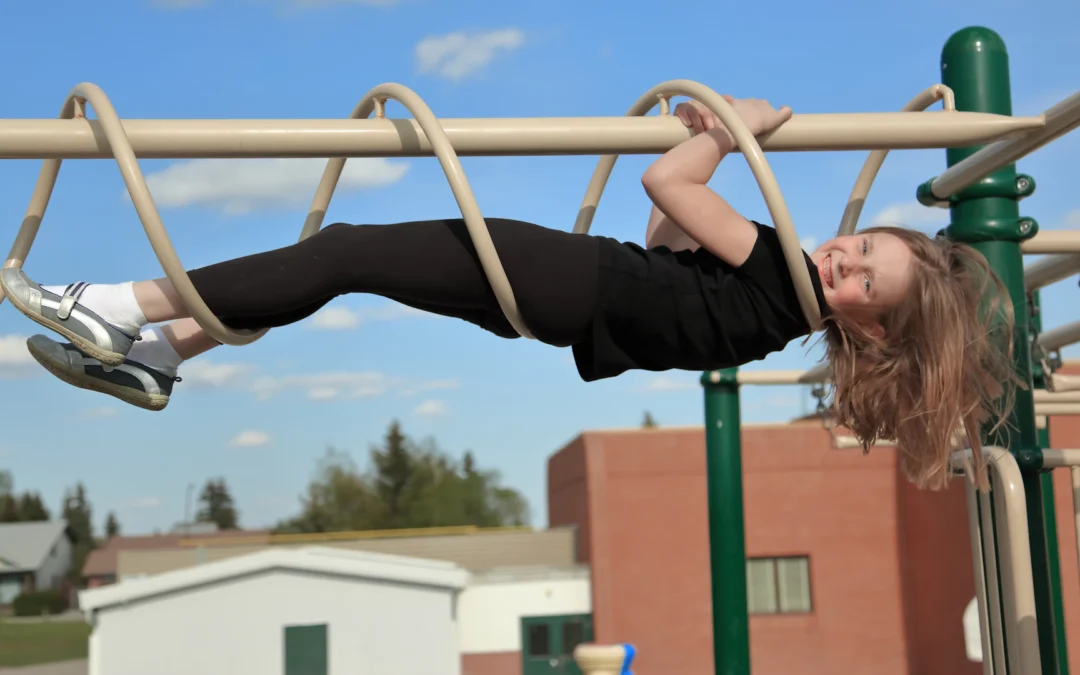
Build a playground where more kids can play: comfortably, confidently, and safely.
Inclusive playground design is more than adding a ramp. It’s thoughtful planning: accessible routes that stay usable over time, play experiences at multiple heights, surfacing that supports mobility devices, and equipment choices that welcome different sensory and physical needs. For Denver-area schools, HOAs, churches, and community spaces, the goal is simple: create a play environment that feels like it was designed for everyone from the start. This guide comes from Rainbow Play Systems of Colorado, a Denver-area playground and sport court company.
What “inclusive” means (and why it matters)
An inclusive playground supports play for children with a wide range of abilities (mobility, sensory, cognitive, and social) without separating kids into “special” areas. Practically, that often includes:
Access: A reliable accessible route that connects entry points to play components (ground and elevated) so kids can move through the space without dead-ends.
Choice: Multiple ways to participate: climb, slide, swing, spin, balance, pretend-play, and engage quietly.
Comfort: Shade, seating, and “pause points” so caregivers and kids can regulate energy, noise, and stimulation.
Safety + maintenance: Surfaces and layouts that stay compliant and usable after months of weather, foot traffic, and seasonal cleanups.
For public-use playgrounds, owners and designers commonly look to recognized guidance around accessibility and surfacing because a route that’s technically “accessible” on opening day can become difficult to navigate if the surface shifts, compacts, or develops ruts. The U.S. Access Board emphasizes that selecting surfacing that can be maintained as accessible is one of the most important planning decisions.
Start with the “path”: accessible routes that actually work
If the route is frustrating, families won’t feel welcome, even if the play equipment is great. A strong, inclusive layout usually includes:
1) A continuous loop (not a cul-de-sac): Design a circulation path that lets kids move through the play space without needing to reverse or backtrack.
2) Wide turning areas near popular components: Swings, spinners, and ground-level panels become natural congestion points; plan breathing room.
3) Clear “zones” with smooth transitions: Active zones (swings, slides) should be separated from calmer sensory play to reduce collisions and overwhelm.
4) Stable surfacing along the route: The route is only as accessible as the surface condition over time, especially after snowmelt and spring storms.
The Access Board also recommends drawing the accessible route directly on the site plan so it’s not treated as an afterthought.
Surfacing: where inclusion and safety meet
For inclusive playground design in Colorado, surfacing tends to be the make-or-break choice. You’re balancing:
- Impact attenuation (how well the surface reduces injury risk from falls)
- Accessibility (stability and ease of rolling/walking)
- Maintenance realities (staff time, seasonal conditions, and long-term wear)
- Budget and lifecycle cost (installation + ongoing upkeep)
For public playgrounds, many owners reference ASTM standards tied to playground equipment and surfacing performance, including ASTM F1487 (public-use playground equipment) and ASTM F1292 (impact attenuation of surfacing in use zones).
| Surfacing Type | Accessibility (Real-World) | Maintenance | Best Fit For |
|---|---|---|---|
| Poured-in-place rubber (unitary) | Usually excellent for rolling and walking when properly installed and maintained | Lower daily raking; periodic inspection/repairs over time | High-traffic community playgrounds prioritizing inclusion |
| Rubber tiles (unitary) | Can be very good; seams and edge transitions matter | Modular repair-friendly; watch for movement and trip edges | Sites wanting easier spot repairs |
| Engineered Wood Fiber (loose fill) | Can start accessible but requires consistent grooming/top-offs to prevent ruts | Higher ongoing labor: raking, leveling, replenishing | Lower upfront budget with committed maintenance plan |
| Synthetic turf systems (with pad) | Often good when designed for playground accessibility and drainage | Infill management and cleaning; heat considerations in full sun | Aesthetic-focused projects seeking a consistent surface |
Practical note: Impact attenuation is commonly evaluated using ASTM F1292 methods and criteria, and maintaining compliance over time can require field testing and a maintenance plan, especially for surfaces that compact or migrate.
Design choices that help more kids participate
Inclusive play is strongest when a child can choose how to engage: active, social, imaginative, or quiet. A few high-impact choices:
Transfer platforms + ground-level play: When ramps aren’t feasible for every structure, transfer systems paired with rich ground-level activities can expand participation.
Panels, music, and tactile elements: These create meaningful play for kids who may not want heights or fast motion.
Accessible swings and inclusive spinners: Consider options that support different postural needs and caregiver assistance.
Quiet “reset” space: A small nook with shade and seating helps neurodivergent kids (and adults) regulate without leaving the playground entirely.
Many inclusive design guides emphasize balancing ramp access with equitable ground-level opportunities, so kids have multiple pathways into play.
Did you know? Quick facts that influence safer planning
ASTM surfacing standards are performance-based. A surface can look “fine” but still needs testing or replenishment to meet impact attenuation criteria in high-wear zones.
Accessible surfacing is a planning priority, not a finishing detail. The Access Board highlights that choosing a surface that can be maintained as accessible is one of the most important early decisions.
Public-use playground planning often references multiple standards. ASTM F1487 (equipment) and ASTM F1292 (surfacing impact attenuation) are commonly cited in safety discussions.
Step-by-step: planning an inclusive playground that holds up in Denver
Step 1: Define who the playground serves
List ages, peak user counts, caregiver needs, and the types of disabilities you want to thoughtfully include (mobility, sensory sensitivity, balance, etc.). This prevents “inclusive” from becoming a vague checkbox.
Step 2: Draw the accessible route first
Before selecting “cool features,” map the route from parking/sidewalk entry through the play area to each accessible component. The Access Board specifically calls out documenting this route on the site plan.
Step 3: Choose surfacing with maintenance in mind
Ask a blunt question: “Who maintains this, and how often?” If your team can’t commit to routine grooming and replenishment, a surface that stays stable and accessible with less daily labor may be the better long-term inclusion choice.
Step 4: Balance elevated play with ground-level “equivalents”
If the playground has an exciting elevated feature (like a tall slide), pair it with a ground-level feature that offers similar engagement (music, cooperative panels, imaginative play, or a spinner that supports multiple body types).
Step 5: Plan for inspection and performance verification
Playground surfacing performance is often discussed in the context of ASTM F1292, and some owners choose periodic field testing in wear zones to confirm the surface still meets criteria. A documented plan helps protect kids and reduces “surprise” repair costs.
Local angle: inclusive playground design in Denver, Colorado
Denver’s climate and usage patterns add a few real-world considerations:
Freeze/thaw + spring runoff: Drainage and base prep matter. Poor drainage can create uneven surfaces and accelerate wear near entry points and slide exits.
Strong sun at altitude: UV exposure can be hard on plastics and finishes. Shade planning also improves comfort and increases how long families stay at the park.
High-use “pinch points”: Busy neighborhood parks and school playgrounds wear out in predictable spots (under swings, at slide exits, and around spinners), so planning for reinforcement or easier repairs pays off.
Inclusive community expectations: Many Denver-area HOAs and public spaces now treat accessibility as a baseline expectation, not an upgrade. Designing inclusively from day one prevents costly rework later.
One more idea: If you’re building a broader “play + sport” community area, pairing an inclusive playground with a nearby modular athletic court can create a multi-age destination. Modular sports surfacing is often chosen for consistent traction and shock-absorbing design features in residential and facility settings.
Want help planning an inclusive playground or play + sport space in Denver?
Rainbow Play Systems (Swing Sets Colorado) supports design, installation, and long-term support for playground equipment and custom sports surfacing, so your plan can look great on paper and work well in real life.
Prefer to explore first? Browse court surfacing options for residential backyards or commercial facilities.
FAQ: Inclusive playground design in Colorado
Is ADA compliance the same as “inclusive design”?
ADA compliance focuses on accessibility requirements for public accommodations and public entities. Inclusive design goes further, offering meaningful play choices, comfort, and social participation for kids with different abilities, not just access to the space. The best projects plan both together.
What’s the biggest mistake with “inclusive playground design”?
Designing inclusion as a final add-on. If the accessible route, surfacing, and circulation aren’t planned early, you can end up with isolated accessible elements that don’t connect well, or surfaces that stop being accessible after a season of heavy use.
How do we think about playground surfacing safety standards?
Many playground owners reference ASTM standards in safety planning. For example, ASTM F1292 addresses impact attenuation performance for surfacing in use zones, and ASTM F1487 relates to public-use playground equipment safety.
Can a playground be inclusive without ramps?
Sometimes, yes, depending on project goals, space, and equipment. Transfer platforms, stable surfacing, and rich ground-level components can expand participation. Many designers aim to balance elevated access with equitable ground-level experiences.
What if we’re planning a school or HOA area with both play and sports?
A combined plan can be a smart use of land: an inclusive playground for younger kids and a nearby multi-sport area for teens and adults. Modular sports surfacing is often selected for consistent traction and shock-absorbing engineering.
Glossary
Accessible Route: A continuous path that connects entry points to accessible play components, supporting movement through the playground.
Transfer Platform (or Transfer Station): An elevated access point designed so a child can transfer from a mobility device onto a play structure.
Use Zone: The area beneath and around play equipment where protective surfacing is typically required to reduce injury risk from falls.
ASTM F1292: A standard specification and test approach commonly referenced for impact attenuation of playground surfacing in use zones.
ASTM F1487: A standard commonly referenced for safety performance of public-use playground equipment.